
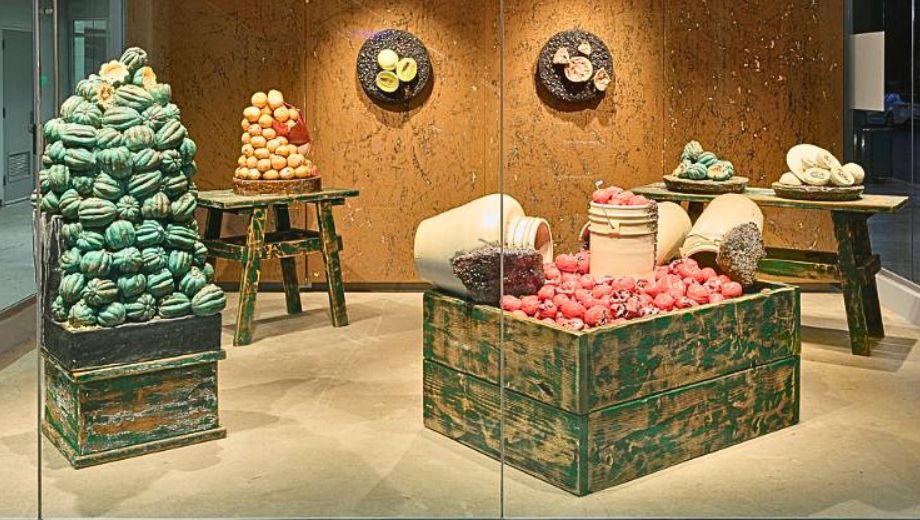
Join us at the Berkeley Art Center for an afternoon conversation with Cube Space Gallery artist Abiam Alvarez and curator Kevin B. Chen.
Hear Alvarez discuss his work, creative process, and the ideas and stories behind his practice. The conversation will take place at the Berkeley Art Center.
In Abundance is on display in the Cube Space Gallery through October 16, 2026.
At this event you can:
- Hear from Cube Space Gallery artist Abiam Alvarez and curator Kevin B. Chen
- Learn about Alvarez’s ceramic work and creative process
- Enjoy refreshments
The event is free and open to the public.
Background
This event is part of a City of Berkeley public art program series that brings artists and community members together for conversations about contemporary art. The series features artists exhibiting in the Cube Space Gallery, located at 2010 Addison Street, Berkeley, CA 94704.
Unlike traditional galleries, its curated exhibits are always visible to the public through three glass walls in a 200 sq. ft. space. The space features a rotating series of three-month exhibitions by emerging and mid-career Bay Area artists.
ABOUT THE ARTIST
Based in Gilroy, CA, Abiam Alvarez’s practice is deeply rooted in the agricultural landscapes of California’s Central Valley. Born in León, Guanajuato, Mexico, Alvarez immigrated to California in 1999 and grew up in the farming community of Firebaugh, located 40 miles west of Fresno. His early experiences working in the fields continue to shape his work, which explores labor, immigration, consumerism, and the socio-political realities of agriculture.
Alvarez creates lifelike ceramic depictions of produce – such as oranges, tomatoes, cantaloupes, and squash – often paired with the vessels, soil, and tools used to grow them. These forms honor farmworkers while drawing attention to the physical and often overlooked labor behind food production. His work frequently contrasts abundance with decay. Fruit may appear plentiful at first glance, but closer inspection reveals signs of rot or imperfection. Through repetition and scale, Alvarez highlights both the bounty of agriculture and the demanding labor required to sustain it, prompting reflection on our own patterns of food consumption.
Embracing the tactile and unpredictable nature of clay, Alvarez values its physicality and its origins in the earth. His process requires both hands-on construction and a willingness to accept uncertainty, particularly during firing, when outcomes remain partially beyond the artist’s control. As Alvarez notes, “A lot could go wrong in the kiln – cracking, exploding, colors not turning out how you envisioned. Even if it survives the first firing, the second could prove disastrous.” This element of risk mirrors the precarity embedded in agricultural labor.
In addition to produce, Alvarez incorporates worn or rusted machinery, pointing to the essential yet often undervalued role of human labor. His work poses a critical question: what would remain if that labor disappeared? His sculptures act as both tribute and warning, emphasizing the deep connections between land, labor, and the food we consume.
Do you know where your food comes from, or how it reaches your table? During the COVID-19 pandemic, workers across critical infrastructure sectors – healthcare, food service, agriculture, transportation, and public safety – continued reporting to work on-site despite widespread lockdowns. Labeled “essential workers,” they kept society running while often facing heightened risks and long-standing inequities. Six years later, many of these workers remain disproportionately represented among low-wage earners, women, and people of color. This installation invites reflection on that reality and recognition of the labor and sacrifice of farmworkers, whose work sustains us every day.
Contact
For questions or to request an accessibility accommodation, please contact msalinas@berkeleyca.gov.