Skip to main content Skip to site search
City of Berkeley

Top Bar

  • Housing Authority
  • Public Library
  • Rent Board
  • School District
City of Berkeley
  • City
    Services
    • Explore city services, report issues online, pay parking tickets

      More about city services

      • Report & Pay
      • Parking
      • Trash & Recycling
      • Getting Around
      • Event Permits & Rentals
      • Livable Neighborhoods
      • Streets, Sidewalks, Sewers, and Utilities
      • Birth & Death Certificates
      • Domestic Partnership
      • Community GIS Portal
      • Current Service Notices
      Report Issues & Pay Bills
      pay parking ticket
      residential parking permits
  • Community &
    Recreation
    • Explore news and events, adopt a pet, visit a city park or pool

      MORE ABOUT COMMUNITY & RECREATION

      • Events
      • News
      • Parks & Recreation
      • Senior Services
      • Volunteering
      • Animal Care Services
      • Civic Arts
      • Waterfront
      • Affordable Housing in Berkeley
      • Community Services
      adopt a pet
      visit adventure playground
      reserve swim session
  • Safety &
    Health
    • Prepare for disasters, report a crime, access homeless services

      MORE ABOUT SAFETY & HEALTH

      • Disaster Preparedness
      • Fire
      • Public Health
      • Police
      • Police Accountability
      • Mental Health
      • Homeless Services
      Fire Weather and Evacuation
      Accessing Mental Health Services
      Accessing Homeless Services
  • Construction &
    Development
    • Apply for a permit, schedule an inspection, research zoning policies

      MORE ABOUT Construction & Development

      • Permits & Design Parameters
      • Seismic Safety
      • Green Building
      • Land Use & Development
      permit service center
      schedule inspection
      look up zoning
  • Doing
    Business
    • Apply for a business license, get business assistance, find bid & proposal opportunities

      MORE ABOUT Doing Business

      • Economic Development
      • Operating in Berkeley
      • Working with the City
      apply for business license
      get business assistance
      bid to work with the city
  • Your
    Government
    • Attend a City Council or commission meeting, apply for jobs, look up City holidays

      MORE ABOUT Your Government

      • About Us
      • Boards & Commissions
      • City Council
      • Elections
      • Financial Information
      • Jobs
      • Our Work
      • Public Records
      • City Holidays
      • Lobbyist Registration
      • City Audits
      apply for a job
      city council meetings
      Participating in Council Meetings
  • Housing Authority
  • Public Library
  • Rent Board
  • School District

You are here

  • Home
  • Community & Recreation
  • Civic Arts
  • Public Art
  • Cube Space Gallery
Share Print

Cube Space Gallery

Visit our gallery in downtown Berkeley to discover our curated series of temporary art installations made by Bay Area artists. 

The City of Berkeley Cube Space is a contemporary art gallery located in the heart of downtown Berkeley at 2010 Addison Street. Unlike traditional galleries, its curated exhibits are always visible to the public through three glass walls in a 200 sq. ft. space. The space features a rotating series of three-month exhibitions by emerging and mid-career Bay Area artists.

Current Exhibition 

BaZi 八字: Ancestral Intelligence, by Ahn Lee

January 2026 - April 2026
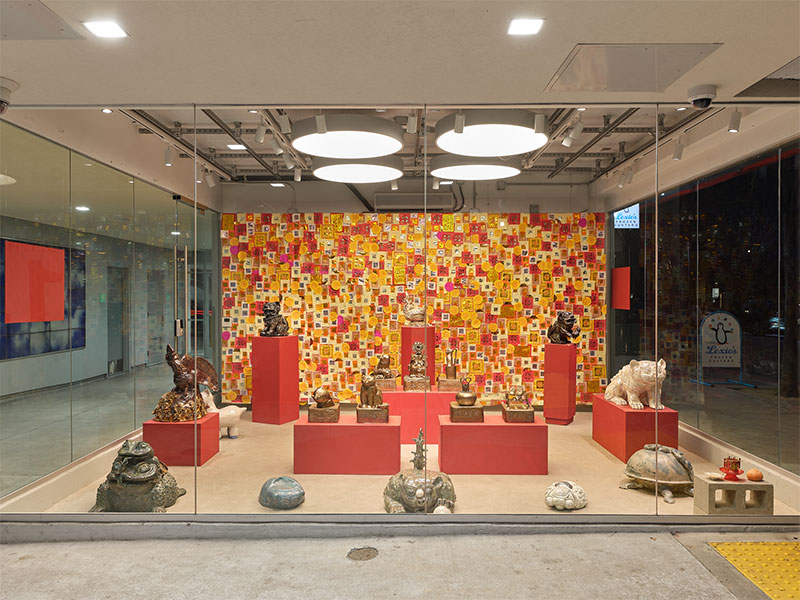
Display of various ceramic animals on pedestals, with back wall covered in small red and yellow pieces of paper

Ahn Lee’s ceramics practice brings together personal storytelling, historical inquiry, and material experimentation. Their work draws on archival research into the Cantonese diaspora while engaging traditions of craft, cosmology, and community knowledge. Through a queer Cantonese lens, Lee examines how histories of capitalism and imperialism shape identity, while imagining futures grounded in ancestral connection. Though academically trained, their approach remains intuitive and embodied, weaving critical history with direct lived experience.

For Lee, ceramics function as both vessel and archive, carrying stories of migration, kinship, and survival while holding space for speculation and transformation. Their practice deepens understandings of Chinese American histories without fixing them in the past. Informed by doctoral research in historiography, Lee expands ceramics beyond object-making, incorporating performance, collaboration, ceremony, and kin-making as integral components of the work. These gestures transform historical absence into presence, foregrounding community as both method and material.

Material process plays a central role in Lee’s exploration of identity. Their study of crystalline glaze chemistry, an ancient technique with origins in China, bridges craft and technology, linking material transformation with cultural meaning. The crystalline surface, formed through precise conditions yet yielding unpredictable results, becomes a metaphor for queer Chineseness: complex, luminous, and continually in flux. Through process and material, Lee positions ceramics as a site where history, identity, and imagination converge.

Lee also draws on BaZi, or the Four Pillars of Destiny, a traditional Chinese metaphysical system that interprets birth data to reveal one’s life path. Studying under a queer Chinese astrologer in the Bay Area, trained by Masters Meng Yu and Zhongxian Wu, Lee reimagines BaZi through a queer framework. They translate their personal chart into ceramic forms representing astrological creatures associated with zodiac animals, elements, and yin–yang energies, mapping identity across past, present, and future.

In a contemporary world where identity is increasingly mediated through social media performance, Lee proposes an alternative mode of self-presentation. By playfully redefining “AI” not as Artificial Intelligence but as Ancestral Intelligence, their work invites consideration of forces beyond individual agency, rooted in lineage, memory, and cosmological time. Through the use of millennia-old systems and material, Lee presents ceramics as a means of connecting ancestral knowledge with present-day lived experience.

@ahnleestudio
www.ahnleestudio.com 
Curated by Kevin B. Chen

Past Exhibitions

Après moi, le déluge by Mary Anne Kluth

October 2025 – January 2026
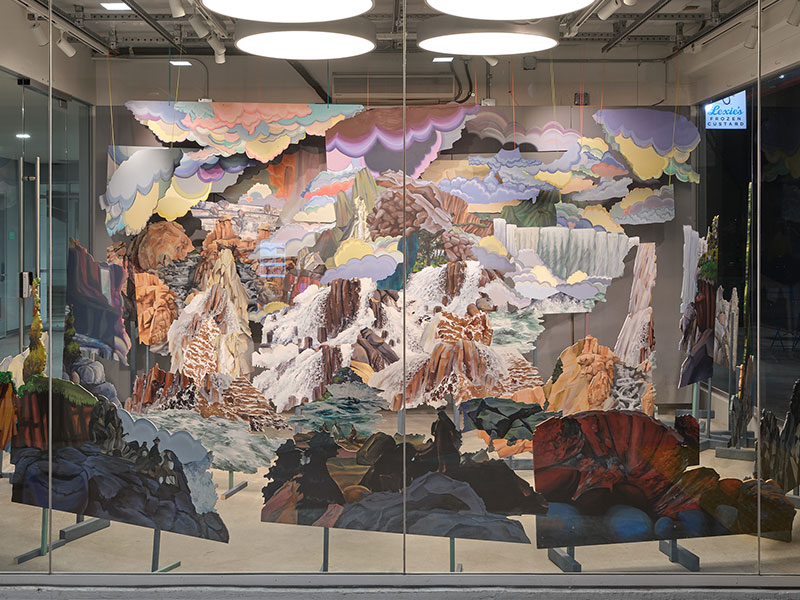
Stage-set panels of wood painted with colorful landscape scenery

Mary Anne Kluth creates landscapes that never quite come together, reflecting the uncertainty in how we see and understand the world around us. Her installations piece together clouds, rivers, cliffs, and glowing horizons, but stop short of forming a complete picture. The result is a space that feels both beautiful and fragile, reminding us that landscapes, like identities, are often constructed.

This sense of fragmentation mirrors our current moment. As we enter the second quarter of the 21st Century, we find ourselves in another technological revolution. If the first 25 years were defined by the internet’s reach into daily life, the present is marked by the rapid rise of artificial intelligence. AI is beginning to reshape how we think, work, and create. Where it will lead remains unknown, and Kluth channels this ambiguity into her practice. 

Kluth’s fascination with illusion began with childhood visits to theme parks, fabricated “outsides” built indoors, and was deepened through time spent in real landscapes with her geologist parents. She also draws on 19th Century painters of the Hudson River School and Western Romantic traditions (Thomas Cole, Albert Bierstadt, Frederic Church, Thomas Moran), whose dramatic compositions mythologized American expansion into the West. Adapting their visual language through theme park imagery, from Disneyland rides to Sanrio Puroland, she employs devices such as darkened foregrounds and glowing horizons while leaving the wooden supports exposed to highlight the artificial nature of both theme parks and the national myths these painters helped create.

With a background in stage-set construction at Children’s Fairyland in Oakland, Kluth builds her installations from handcut wood painted with acrylics. More recently, she has turned to the generative AI program Stable Diffusion, prompting it with Romantic landscape titles to produce synthetic versions of canonical works. She then repaints these computer-made images by hand. In doing so, she draws attention to the hidden act of theft behind the technology – AI companies training their models on artists’ work without permission. By folding this act of appropriation back into her own landscapes, Kluth asks us to reconsider authorship, illusion, and the stories we attach to land and identity.

@makluth  
www.makluth.com 
Curated by Kevin B. Chen 

I call her and ask for a little magic / La llamo y le pido por un poco de magia by Carolina Cuevas

July 2025 – September 2025

Fiber art installation with large braided ropes and textiles in a glass-fronted gallery.

In I call her and ask for a little magic / La llamo y le pido por un poco de magia, Carolina Cuevas draws from the Caribbean devotional tradition of promesas—sacred commitments made to invoke miracles. Her work transforms this practice into a language of materials: woven jute becomes a calendar of devotion; clay, a vessel for memory; and chalk, a fleeting trace of prayer. It consists of a large woven jute form, cascading like bundled hair or rope across the space, accompanied by chalk texts along the floor offering prayers and wishes, and painted eyes that quietly watch. Through these elements, Cuevas crafts an altar not for a saint or deity, but for time itself—its burdens, its passages, its quiet, daily acts of care.

Promesas— the Spanish word for “promises”—have long formed a quietly powerful current in Caribbean and Latin American devotional life. Traditionally, they involve vows or offerings made to saints or deities in exchange for divine intervention. These practices are embedded in daily life and involve sustained and repetitive commitments for a set period of time. While deeply personal and often private, promesas can echo across generations—becoming family rites of gratitude and remembrance.

The installation evokes her personal memory of a promesa made by her father: to grow his hair for six years, each day marked by her mother’s hands braiding it. This intimate act becomes a symbol of love and unspoken faith. Here, Cuevas replicates this gesture in fiber, creating hair-like weavings that speak of spiritual endurance, tactile remembrance, and the rituals we perform for those we love. Painted eyes peer from the windows, evoking Caribbean symbols of protection. Words drawn in chalk are meant to fade. Everything here holds the possibility of disappearance over time, even as it maintains its current presence. The work invites us to reconsider where faith lives, be it in hair, in hands, or in moments.

Carolina Cuevas is an interdisciplinary artist whose practice centers on the tactile and devotional relationship between body and material. Through weaving, clay, and ephemeral acts of performance, she explores oral traditions, the passage of time, and the stories that reside in everyday rituals. Her process is rooted in a deep intimacy—thread passed between hands, words folded into fabric, clay molded as a form of remembering. Drawing from her Caribbean heritage and family histories, Cuevas views language as something lived: found in a mother’s gaze, a sister’s laughter, or the silent devotion of a partner. Her work often navigates the tensions of belief and labor, presence and loss, and permanence and transience. By engaging with impermanent materials and inherited forms of care, she constructs living altars that speak to resilience, spiritual inheritance, and the embodied nature of storytelling.

Para mi mama que siempre me da un poco de magia.

@Carolinac16
Curated by William Hernandez Luege.

The Architectural Veil by Joanna Keane Lopez

April 2025 – June 2025 

wooden art surrounded by gray

Decorative wooden thresholds, like the one seen here, are found all across the American Southwest and feature prominently on the balconies of California’s Spanish-style homes. This ornamental screen, called a mashrabiy’ya, was used in traditional North African and Middle Eastern architecture to create a boundary between inside and outside spaces. It offers privacy while still allowing air and light through, enabling both visibility and concealment, control and openness. Traditionally, they were used in the practice of protecting or covering things considered sacred.

In The Architectural Veil, Bay Area-based artist Joanna Keane-Lopez reinterprets this form through ponderosa pine and bolsters the design with earthen adobe, quartzite stone, and woven textiles—substances that trace a history of architectural movement from Western Asia and North Africa to Spain and the Americas. These components are shaped by colonial expansion, Indigenous traditions, and the layered connections between craft and construction that emphasize the sanctity of natural resources. The built environment of the “American West” is a legacy that spans continents, and these aspects of the installation each evoke a component of this story.

By transforming structural features into sculpture, The Architectural Veil asks how materials contain cultural memory and how the spaces we inhabit shape our understanding of belonging and separation. This exhibit opens a space for reflection, urging us to consider how the built world, both industrial and handcrafted, is never a given but always the result of long processes of migration, adaptation, and transformation.

Joanna Keane Lopez (b. 1991, Albuquerque, NM) is an artist whose work is informed through adobe, paper, clay, wood, and textiles. She inherited the practice of working with adobe from her family in New Mexico and continues the teachings of enjarradoras and adoberas, women who specialize in the traditional craft of earthen architecture. Keane Lopez’s practice restores the loss of vernacular land-based building methods through the production of sculpture, installation, and hands-on educational workshops that navigate loss, fragmentation, nuclear land contamination, and materiality.

@jokeanelopez
www.joannakeanelopez.com 
Curated by William Hernandez Luege.

Rock Paper Scissors by Anamaya Farthing-Kohl

December 2024 – March 2025

Dark wooden object sits on light wooden bench
Found objects

They are looking at you. Welcome to the stage.

Anamaya Farthing-Kohl (Bolivia, 1988) is an artist based in the East Bay who makes work in collaboration with the public, often asking for help in defining, circulating, or discovering their work. Anamaya is attracted to mundane objects that have a large public presence, but that often go unnoticed. Their interventions investigate possibilities for an afterlife for things that honor their life as social beings. Anamaya has also worked in communities as a teaching artist, engaging students through activity to challenge them to ask questions.  Much like their work, the goal of these educational projects is not to praise but to use art to legitimize thinking.

In Rock Paper Scissors, Farthing-Kohl presents a world where perception is turned upside down. Set on curved bleachers—structures that recall ancient amphitheaters, modern stadiums, and other theatrical seating—this installation presents sculptures made from decaying industrial materials like concrete, asphalt, and metal. Their surfaces are printed with images of devices like coin-operated viewers, televisions, globes, microscopes, and other devices used to frame, magnify, and control our view of the world. Here, those tools of vision seem to watch us back. Seated on bleachers, these sculptures stare at us, turning this space into a theater, not unlike those on the nearby street. The result is a theatrical environment where the human eye is no longer the central arbiter of truth. Dramatic lighting, reminiscent of cabaret, sets the stage for sculptures that challenge our expectations of what objects are and what they can do. These works disrupt fixed, stage identities of person, object, and subject. They are not passive artifacts but spectators—decaying, ambiguous, alive with possibility as we walk into the show.

What might they think of us? How might they interpret our presence, our habits, our gaze? Farthing-Kohl's work teases these questions, reframing the relationship between object and subject, between spectator and spectated with a sense of play and provocation. These decaying forms are neither fully alive nor inert, neither entirely themselves nor their printed images. By giving these objects a voice (or at least the possibility of one) Farthing-Kohl challenges us to see the world as less stable, less knowable, and infinitely more alive. It is a stage where objects demand to be noticed not as things, but as active, curious presences.

www.anamayafarthingkohl.com  
@Sweatymagnolia
Curated by William Hernandez Luege.

Bent Grass by Emily Gui

September – November 2024 

blue fabric draped over pile of dry grass

In Bent Grass, artist Emily Gui presents an installation of foraged dried grasses, over which a roll of gridded prints is suspended, evoking the nearby Berkeley Hills. Inspired by the seasonal changes in the Bay Area, with its cycles of verdant green and decaying brown, Gui reflects on how our perceptions of something as seemingly innocuous as grass can shape our relationship to the local landscape. If we look closer—at manicured lawns, livestock pasture, and native grassland, we can recognize that the golden hills are often a mixture of species both introduced and endemic to our area. Whether it’s the seasonal wildfires that plague California or the class and cultural significance of a pristine, green lawn, Gui invites us to slow down and consider the materials we take for granted.

As a printmaker, Gui often works with duplication and artifice. The printing process copies a single image and replicates it as many times as one might wish. When considering the way in which lawns interact with grasses, Gui saw a similar kind of action, where patches of pre-grown material are purchased on demand and pressed into the ground, resulting in a social image of the perfect lawn for the all-American home. But as American as a lawn might seem now, the initial concept was brought to this country during colonization and the species pictured were imported, mostly from Europe. In California, this artifice is not only "unnatural" but can be actively harmful. Contradictions are at the heart of this relationship—a given patch of green grass can symbolize both wasteful over-watering and respite from drought when rains return. And while fire can be destructive, cultural burns, like those practiced by the Ohlone people in this area for thousands of years, help to mitigate wildfire, restore land and promote growth. Like the roll of printed grass, this thin veneer of lawn work rests atop the realities that many of us have decided are not worthy of equal consideration. Bent Grass reminds us to look under the artifice and reflect on the landscape that is fabricated, wild or somewhere in-between.

www.emilygui.com   
@Blue__prints
Curated by William Hernandez Luege.

On the Currents of Inherited Dreams by Kira Dominguez Hultgren

July – August 2024

Blue yarn art wrapped in looms that looks like a bridge

Crisscrossing the bay, looking up at towers that hold cables like loom heddles hold yarn, a bridge becomes a loom becomes a bridge. It’s my body that is woven into remapped coastlines as I shuttle myself from place to place, across bridges and steel cables like looms dressed in yarn that pick up, displace, misplace, and replace stories each time we pass through.

How does one pick up a story-in-motion? I could start with origin stories in Punjab, Vancouver, and Chihuahua. I could start with my grandmother’s experiences on Hollywood sets and the Chemawa Indian School. I could start with my dad skirting the blocks around Toberman Park in Los Angeles and later the halls of Boalt Law School at UC Berkeley. My family fabric is a collision of stories-in-motion, a material that keeps changing as each generation figures out how to pass it to the next.

This work is dedicated to my parents and grandparents who figured out a thousand ways to pass through a U.S.-bounded fabric, to change the shape of it, and to leave the spaces for our story to be heard in present tense and reverberating echoes. It’s because of them that I can pick up and pass through threads of puckered, twisted, folded, shredded, and entangled currents of history.

@kiradominguezhultgren 
Kiradominguezhultgren.com

The last muffled breaths of the undead masculine by Weston Teruya

April – June, 2024

Papier mache sculpture of a string of large beads, hanging foot, and a megaphone

For this exhibition Weston Teruya creates paper sculpture using cast papier-mâché, integrating recycled office supplies, soil gathered from former environmental impact sites, and electronic components. Over the course of this exhibition, this installed mechanism will change, grow, and fall apart. The sculpture will turn in on itself, breaking itself apart. Rather than reveling in the destruction, the artist invites viewers to see the artwork’s disintegration as part of an ongoing process of exhalation: Reminding us that we breathe to clear space for a cycle of new growth. 
 
Weston Teruya is an artist and cultural organizer who moves between individual and collective modes of practice to explore personal and community responses to inequity and fragmentation, with listening and inquiry as the starting point for creative reflection and making. His individual art practice draws on the interplay of research and material exploration to create sculptural installations–often from a variety of paper-based media. In those sculptures, he examines the social dynamics, textures, and histories of specific sites and communities.

www.westonteruya.com  

Khepri by Ebti Shedid 

January – March 2024 

Wire and light bulb hang above a pile of light bulbs on a large square mirror

Khepri 

God of creating – rebirth- morning sun 
Becoming into being daily 
I die again and rise again and again 

With every death comes a re-birth. 
Loss results in abundance. 
The sun sets every night and comes up every day. 
An endless cycle of death and rebirth 

Khepri is a material meditation on the cycle of life and death. Khepri, also referred to as dongbeetle, represented rebirth in ancient Egypt. Holding this history, Ebti believes the lightbulb in the space represents the essence of her late father’s spirit —a mark of rebirth. Informed by her family’s making-traditions and antique gallery, she incorporates relics that attempt keep cultural and personal memory close with a deep understanding that loss is inevitable. 

IG: @ebtiebtiebti 
www.ebti.art  
Curated by Leila Weefur.

Throughway by Kerri Conlon

October – December 2023 

Blue net hanging in an undulating form

Kerri Conlon’s installation, Throughway, is a material meditation on societal transformation within human networks and the interconnectivity required for them to form and bond. As with most social structures, this work also sees the potential for collapse. Inspired by the intricate design of lobster traps, the work visualizes the network as a series of actions and beliefs looped together to initiate change. Each of its corners and peaks builds a pattern that curves back and forth making a path along the edges of the space, and terminates with an upholstered umbrella tail bead hat receives the impact of the undulating form.

Conlon’s study of structure and architecture is evidenced in her ability to explore the possibility of change using a material that is strong enough to contain a mass but can be broken with the right amount of pressure. It is a reminder of the human capacity to make a social impact amidst the chaos.

IG: @kerriconlonstudio
www.Kerriconlon.com 
Curated by Leila Weefur.

been here by Charles Lee

July – September 2023

Hay bales surrounding a collage and video projection of a Black cowboys

been here. is an excavation of the archive containing evidence in this poetic narrative of the African American Cowboy. Charles Lee’s installation of found objects is a reliquary that cultivates a deeper understanding of American iconography and uncovers the misconception that often surrounds familiar cultural representations, such as the American Cowboy.  By using the archive as a resource to build a more inclusive and accurate vision this work embraces the complexities of our shared history, and facilitates a sense of belonging and community. Inspired by his family's migration story, which like most Black Americans in California means movement West from the Jim Crow South, Lee is examining, through deep research, the ways cultural heritage shapes contemporary American Life. His sculptural compositions illustrate a thoughtful narrative asserting historical presence on behalf of his family and the greater history of the Black Cowboy.

Curated by Leila Weefur.

SIN DOMINGOS by Pablo Tut

January – May 2023

Installation of sculpture piece featuring a hammock

SIN DOMINGOS - (sin: without) (domingos: Sundays) is a sacred day of rest, as it was the day that God rested after finishing the world’s creation. Drawing inspiration from the double meaning of this phrase Without Sundays/ Sinful Sundays, this installation is an abstract representation of the crucifixion, a multilinear crucifixion. Nested in a hammock lays an undetermined body referencing the figure of Christ, with an arbitrary number of nails in various locations. The design of the hammock is one that you would typically see from the peninsula of Yucatan, Mexico where the artist is from. This bodily form is also a tired worker whose rest in the hammock is interrupted by this stream of wire. This juxtaposition of objects is a commentary on how resting, especially on Sundays, is perceived as sinful in an exploitative work culture. Tut offers an interrelated flow of cultural tensions between objects that illustrate what results from the hybridization of work and rest.

@pablo_tut
www.pablotut.com 
Curated by Leila Weefur.

Structures by Cathy Lu and Tracy Ren

September 2022 – January 2023

A sculpture of bamboo scaffolding holds up bags of produce
Photo by Dianne Jones Photography

This collaborative work by Cathy Lu and Tracy Ren explores the structures that hold our communities and ourselves together through time and space. Bags of ceramic fruits and photographs of hands printed on fabric hang off a bamboo composition inspired by the scaffolding used for construction in Hong Kong.

The ceramic forms are based on fruits sourced from local Chinese American produce markets, while the photographs are selections from Tracy's family archive. Together, the work focuses on fleeting relational moments between family members, and the objects and skills that are passed down through generations. 

Cruising into Becoming by Leonard Reidelbach 

January – August 2022

Modern art installation

Leonard Reidelbach’s installation cruising into becoming is a material, spiritual and social exploration of embodiment. Through an emphasis on touch and intimacy, this work urges you to cruise toward your own recessed desires. The images resting on the surface of these materials build a poetic texture to an alternate world. If you look closely, a pattern emerges which transports the past and recontextualizes itself across time and space.  

Curated by Leila Weefur. 

Trans Boxing: Remote Pictures by Nolan Hanson and Ada Jane McNulty

August – December 2021 

Transboxing
Photo by Kija Lucas.

For their exhibition in the Cube Space Gallery, artists Nolan Hanson and Ada Jane McNulty invite the public to view archival materials from the past year of Trans Boxing. The multimedia installation includes a portrait series, screenshots from virtual classes, and other visual material produced by participants, alongside sculptural elements which evoke the experiential and aesthetic qualities of a boxing gym.

Trans Boxing is an ongoing co-authored art project in the form of a boxing club that centers trans and gender variant people. The project shifts in response to context and conditions and continuously reimagines possibilities for social engagement. Trans Boxing was founded in 2017 by Nolan Hanson and is housed in New York City. Ada Jane McNulty is an artist living in New York City. She spends her time in photography, boxing, skateboarding, and anti-capitalist organizing.

Curated by Leila Weefur.

In this section
Public Art
  • Cube Space Gallery
  • Downtown Berkeley BART Plaza

News

People of all ages gather on a sunny day at a lively outdoor festival with white canopy tents, hay bales, and fall decorations. Children and adults walk through the event, visit booths, and sort through a large pile of donated clothes in the foreground.

Artists and festival organizers can apply for arts grants

Multicolored metal sculpture.

Seeking artists for new public art for new City park

A metal sculpture stands in front of a the blue sky above the Berkeley Marina, with sunlight streaming from the top corner. White text on the image reads, “Berkeley poets: apply to become next Poet Laureate.”

Apply now to be Berkeley’s next Poet Laureate

blue tile

Weigh in on five proposed mosaic designs for City community center

More News
Civic Arts Program
Email: civicarts@berkeleyca.gov
Phone: (510) 981-7530
infrastructure

Provide state-of-the-art, well-maintained infrastructure, amenities, and facilities

View Our Strategic Plan

WE’RE HERE TO HELP

Connect with us online, by phone, or in person.

Footer Top

Report Online Contact us Visit
City of Berkeley
2180 Milvia St, Berkeley, CA 94704

Footer Social

Footer Right

  • Sign Up for Our Newsletter
  • Get alerted about emergencies

Footer

  • Departments
  • Permits
  • Records Online
  • Events
  • Jobs

Footer Bottom

  • Accessibility
  • Privacy Policy
  • Website Policy
  • Website Feedback
 

Translation Disclaimer

© 2026 City of Berkeley All rights reserved.