
PROJECT LOCATION
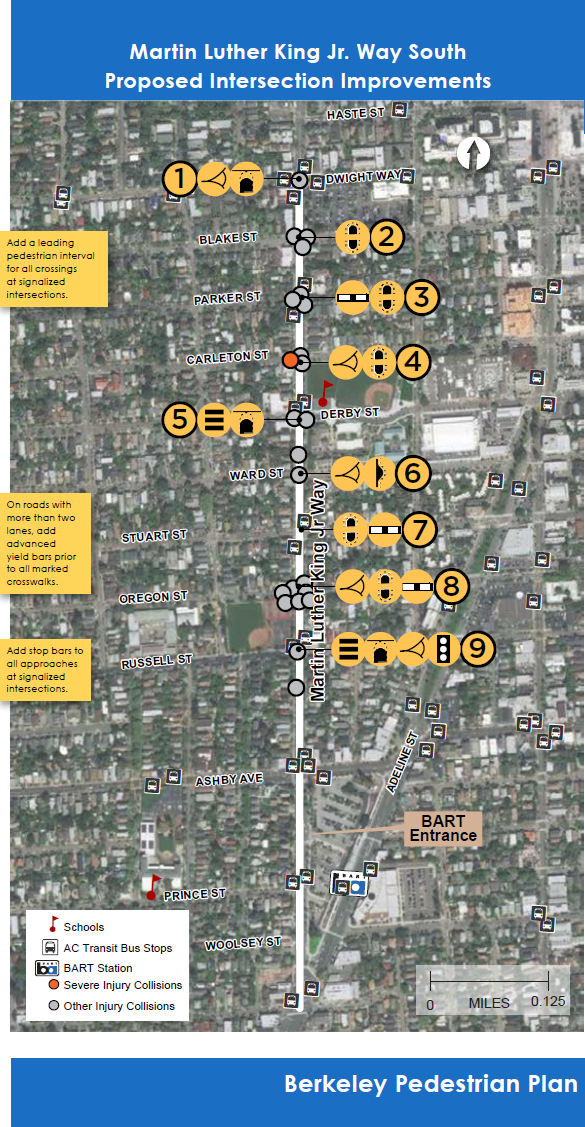
A half-mile stretch of Martin Luther King Jr. Way at the following series of intersections: Dwight Way, Blake Street, Parker Street, Carleton Street, Derby Street, Ward Street, Stuart Street, Oregon Street, Russell Street.
WHAT'S HAPPENING
This road had been one of the most dangerous in all of Alameda County for pedestrians and bicyclists:
- Between 2010 and 2019, there were 48 pedestrian collisions and 46 bicyclist collisions in the project area, including 8 severe pedestrian collisions.
- There have been collisions at each project intersection
- collisions in the project area have increased at an alarming rate of 64% each year
Drivers are not following posted, routine laws in this area:
- Over half of all pedestrian collisions during this same period (62.5%) were due to drivers failing to yield to pedestrian right-of-way (ROW).
- Three-quarters of all collisions involved pedestrians crossing in crosswalks along the corridor.
- The posted speed limit of the corridor is 25 miles per hour, but vehicular traffic has been regularly observed exceeding this limit.
The elements we’ve added to the street will reduce pedestrian exposure, increase their visibility, help vehicles yield to them, slow vehicle turns and calm traffic.
- Reduce pedestrian exposure at crossings/intersections by using median refuge islands and temporary curb extensions,
- Increase pedestrian visibility by daylighting crosswalks using red curb,
- Increase pedestrian yield rates by installing Rectangular Rapid Flashing Beacons and advance yield limit lines and signs at Oregon, Stuart, and Parker streets. (Studies show these beacons can increase motorist yielding rates by up to 98%.)
- Slow vehicle turning movements by using median refuges, hardened centerlines, and temporary curb extensions.
- Calm traffic by using median refuge islands
Lower traffic speeds will create safer road conditions for people walking, and reduce the severity of pedestrian crashes when they do occur. Although the project’s focus is on pedestrian safety, traffic speed reductions will also increase bicyclist comfort and safety riding along and crossing MLK Jr. Way.
Legislative History
These issues have been documented in the Berkeley Vision Zero Action Plan (2020) and the Berkeley Pedestrian Plan (2021), where Martin Luther King Jr Way is identified as a high-injury street for severe and fatal traffic crashes involving pedestrians.
In response to these issues, on May 28, 2019, the Berkeley City Council referred to the budget process a request for funding of traffic safety improvements at the intersection of Martin Luther King Jr. Way and Stuart Street. On June 30, 2020, the Berkeley City Council approved a grant application for pedestrian crossing safety improvements along Martin Luther King Jr. Way between Russell Street and Dwight Way.
Project Elements
Note: Not all of these elements will be installed at each of the project intersections.
- Improving sightlines through red curbing the approaches at crosswalks
- Pedestrian refuge islands
- Hardened centerlines
- High-visibility crosswalks
- Advanced yield markings and signage
- Rectangular rapid flashing beacons (RRFB)
- Lighting at crosswalks
Quick-Build
What is a “quick-build” project?
This is the definition from the California Active Transportation Program (ATP):
Quick-Build projects are interim capital improvement projects that further the goals of the ATP. These projects do require minor construction activities but are built with durable, low to moderate cost materials, and last from one year to five years. These projects have moderate design flexibility to anticipate some adjustments that may occur. The purpose of a Quick-Build project is to immediately implement safety needs, allowing a community to benefit quickly from improvements made, and allowing the people of a community affected by the project to provide input and test the project improvements before they are permanently constructed.
Quick-Build projects are distinguished from temporary demonstration projects by the types of materials used and a longer study duration. However, unlike traditional capital projects, Quick-Build projects can be adjusted; they can be changed based on community input and further technical analysis over time. If the Quick-Build project is successful, it can later be made permanent. If it is not successful, it can be easily deconstructed. Quick-Build projects are intended to remain in place until capital upgrades are possible. All Quick-Build projects are expected to collect data to inform the approach for the project.”
Project Timeline
- Grant application awarded: March 25, 2021
- Design: November 2021 – August 2022
- Construction Phase I: September 2023 – January 2024
- Construction Phase II: May 2024
Funding
This Project is funded by a $600,000 State of California Active Transportation Program.
Images
MLK Quick Build